
EduTalk: AI Won’t Replace Teachers - but It Will Certainly Replace This Kind of Teacher
- Henry Maximus C

- Jun 10
- 3 min read
The wrong question people always ask is this: “Will AI replace teachers?”
As AI tools become more advanced, this question keeps popping up in discussions about the future of education. AI can now explain concepts, generate lesson plans, create quizzes, and even offer personalized tutoring in a split second.
But perhaps we're so fixated on whether AI will replace teachers, we forgot to ask the REAL question: with AI, will certain teaching methods become useless?
The End of Information Monopoly
For decades, teachers were the primary source of knowledge in the classroom. Students depended on educators because information was difficult to access.
Today, that reality has completely changed. Students can instantly search for explanations through Google, YouTube, or AI tools like ChatGPT. Information is no longer scarce.
And honestly, if you agree that teaching only means delivering information, AI may eventually do it faster and more efficiently. That does not mean teachers are becoming irrelevant. It means the role of teachers is evolving.
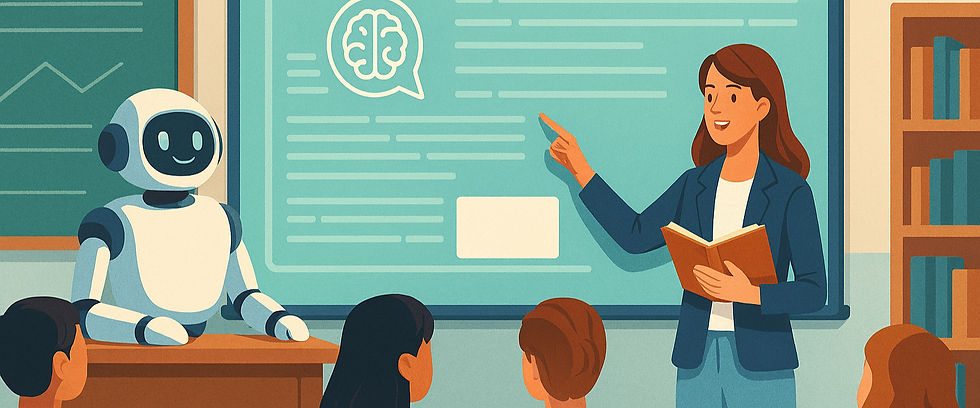
What AI Cannot Easily Replace
Great teachers do far more than explain textbook content. They motivate the shy, encourage curiosity, build confidence, guide critical thinking, etc. They understand classroom dynamics better than anyone and can create meaningful learning experiences.
AI may be able to provide answers quickly, but that's not what education is truly about, right?
AI can generate information, but it cannot truly replace human connection, mentorship, or empathy. This matters even more in modern education, where student engagement and autonomous learning are becoming increasingly important.
Are you the kind of teacher who is at risk?
Ironically, the teachers most likely to be affected by AI are not necessarily the least knowledgeable. In fact, they may be an expert in that field. However, they are also likely the ones whose teaching relies entirely on lectures, repetition, and standardized answers - the "old-school" way.
In many exam-focused education systems, students are trained to memorize information rather than develop critical thinking skills. But in the AI era, memorizing facts is becoming less valuable because information is already everywhere and easily assessible.
What students need now is guidance on:
how to think critically
how to analyze and compare information
how to ask better questions
how to learn independently
The future of teaching is not about competing with AI. It’s about teaching what AI cannot do well.
From Purely Content Delivery to Learning Design
The role of teachers is rapidly evolving. Educators are no longer simply content providers. Increasingly, they are becoming:
facilitators of discussion
mentors for self-directed learning
designers of learning experiences
guides for critical thinking
This shift is reshaping the future of education. Teaching is no longer just about helping students find answers. It is about helping students understand, apply, and question information.
A Future That Requires Better Teachers (Not Fewer!)
AI will undoubtedly transform education. Some traditional teaching tasks may become automated, but meaningful education has always been about more than transferring knowledge.
The teachers who will thrive in the future are the ones who are still able to inspire curiosity, develop critical thinking, and help students adapt to change.
AI will not replace teachers. But it will certainly force educators to rethink what great teaching actually means.
Final Reflection for You
Think about this: If students can already get answers from AI within seconds, what unique value does your classroom still provide?
IPPAcademy | Professional Development for Modern Educators
At IPPAcademy, we support educators through professional development courses focused on:
AI in education
ESL teaching strategies
classroom management
modern teaching methods


Comments